







Learn how biweekly loan payments align with weekly, biweekly, and monthly pay schedules in Utah for better repayment planning and timing.
When applying for a personal loan, most people focus on the amount they need.
But what actually matters over time is how the repayment fits into your income cycle.
Repayment is not just a requirement—it reflects how consistently you manage your financial commitments.
In Utah, personal loan repayments are usually structured in two common ways:
- Monthly
- Biweekly
Both are simple, but choosing the right one depends on how you receive your income.
Understanding this alignment can make repayment more predictable and easier to follow.
Why Repayment Timing Matters
Before choosing between payment schedules, it helps to understand the loan repayment structure and timing, including how different repayment models are designed and what to expect throughout the loan term.
A loan is not a one-time event.
Once you receive the amount, repayment becomes part of your routine.
If repayment timing does not match your income:
- You may need to adjust your expenses
- You may need to hold funds longer
- It may feel harder to stay consistent
But when repayment aligns with your pay schedule:
- Payments feel more natural
- Budget planning becomes easier
- Consistency improves
That’s why choosing between monthly and biweekly payments matters.
Understanding Biweekly and Monthly Payments
Before comparing, let’s keep the basics simple.
Monthly Payments
You repay once every month.
This works well if:
- Your income comes once a month
- Your expenses are planned monthly
Biweekly Payments
You repay once every two weeks.
This works well if:
- Your income comes every week or every two weeks
- You prefer smaller, more frequent payments
How Biweekly Payments Work in Practice
Biweekly payments divide your repayment into smaller parts.
Instead of one larger monthly payment:
- You make two smaller payments within a month
This creates a steady flow of repayment.
Many borrowers find this easier because:
- The payment amount is smaller
- It aligns closely with regular income cycles
Why Biweekly Payments Feel In-Line with Scheduling
Biweekly payments are often considered easier to follow—not because they reduce the total obligation, but because of how they are structured.
Here’s why:
- Smaller payment amounts feel easier to plan
- Payments align closely with regular income
- There is less gap between earning and repayment
For example: If you receive income every two weeks, making a payment during that cycle feels more natural.
How Monthly Payments Work
Monthly payments are straightforward.
You:
- Receive income
- Plan your expenses
- Make one repayment
This works well when:
- Your income is fixed monthly
- You prefer handling payments once per month
However, the payment amount may be higher compared to a single biweekly installment.
Biweekly vs Monthly: A Practical Comparison
Let’s look at a simple comparison:
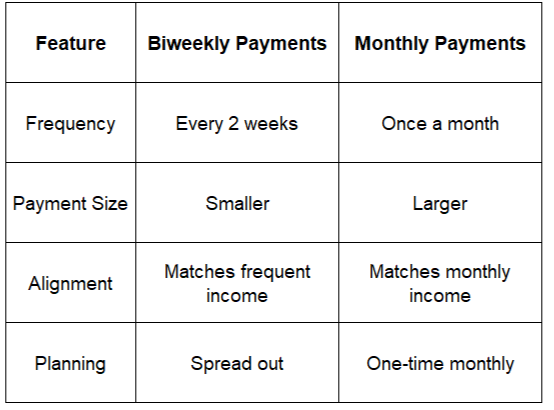
The choice is not about which is better overall—it’s about which fits your income.
A more detailed explanation of repayment differences can also be found in our guide on how installment loans are structured, which explains how payments are divided over time.
How Loan Repayments Align With Different Pay Schedules
Now let’s connect this to real situations.
If You Are Paid Weekly or Biweekly
Biweekly repayment usually fits better.
Why?
- Your income and repayment follow the same cycle
- You don’t need to hold funds for a long time
- Payments feel more consistent
If You Are Paid Monthly
Monthly repayment works better.
Why?
- You receive income once a month
- You can plan all expenses together
- One repayment fits naturally into your budget
If Your Income Varies
In cases where income is not fixed:
- Choosing smaller, more frequent payments may help
- It allows better adjustment within shorter cycles
The goal is not to choose a standard repayment option, but to select one that fits naturally into your income cycle without requiring constant adjustment.
Why Alignment Is More Important Than the Payment Type
The key idea is simple:
The repayment schedule should match your income—not the other way around.
When repayment is aligned:
- You don’t need to rearrange your budget frequently
- Payments become part of your routine
- Consistency improves over time
This is what makes repayment easier to manage.
A Simple Example
Let’s say your loan repayment is structured in two ways:
Monthly Option:
- $400 per month
Biweekly Option:
- $200 every two weeks
Both cover the same obligation.
But if your income comes every two weeks:
- Paying $200 from each paycheck feels more natural
This is how alignment works in real life.
What Many People Overlook
A common mistake is choosing repayment without thinking about income timing.
People often:
- Choose monthly because it feels standard
- Or choose biweekly without checking income flow
Later, they realize:
- The timing doesn’t match
- Budget adjustments are needed
This can be avoided with a simple check before applying.
It’s also useful to review how personal loans work in Utah, since repayment structure is directly connected to how the loan is issued and managed over time.
Many of these situations are also explained in more detail in our guide on common mistakes borrowers make when applying for a loan, where timing and repayment planning are often overlooked.
How to Choose the Right Repayment Structure
You don’t need complex calculations.
Just follow a simple approach:
Step 1: Check Your Income Frequency
Is it weekly, biweekly, or monthly?
Step 2: Review Your Expenses
Are they spread out or concentrated at one time?
Step 3: Match the Repayment Cycle
Choose the structure that aligns naturally with your income.
Step 4: Keep It Consistent
Once chosen, follow the same pattern throughout the loan term.
Before finalizing your choice, it may also help to review what borrowers should know before applying for a personal loan, especially when aligning repayment with income.
Where This Fits in Personal Loan Planning
Repayment alignment is just one part of a bigger picture.
Before applying, it also helps to review:
- Loan structure and repayment clarity
- Overall cost and duration
- Your existing commitments
These small checks create a more complete plan.
If you're comparing repayment options, you may also want to explore how to manage personal loan repayments effectively, including planning techniques based on income timing.
FAQ Section
Are biweekly payments better than monthly payments?
Not necessarily. Biweekly payments work better for frequent income, while monthly payments suit monthly income. The right choice depends on your pay schedule.
Do biweekly payments reduce the total loan cost?
They don’t change the structure automatically, but they can make repayment feel more consistent and easier to manage.
Can I switch between monthly and biweekly payments later?
It depends on the lender and loan terms. It’s best to choose the right structure before starting.
Which repayment option should I choose if I get paid every two weeks?
Biweekly repayment usually aligns better because it matches your income cycle. This makes it easier to manage payments without adjusting your budget each month.
Conclusion
Loan repayment is not just about paying back what you borrow—it’s about how well it fits into your everyday financial routine.
Biweekly and monthly payments are both simple structures.
The difference comes down to alignment.
When your repayment matches your income:
- Planning becomes easier
- Payments feel more natural
- Consistency improves over time
If you are looking for a personal loan in Utah and prefer a repayment structure that aligns with your pay schedule, you can apply with Desert Rock Capital. They offer biweekly payment options, make a quick decision in about 30 minutes, and provide loans without checking your credit score.